Showing posts with label Gluten free Indian food. Show all posts

Monday, October 8, 2018

Lunch From The Garden : Bitter melon, Eggplant, and Potato

    
   One thing is clear now that Alan is eating a mainly vegetarian diet with occasional forays into fish, we are really and truly cleaning out our garden. Every spring I plant a lot of vegetables, 3 or 4 varieties of eggplants, 3 types of peppers, squashes, tomatoes, tomatillos, potatoes, beets plus various herbs. This year I also planted bitter melon since I was tired of 50 mile round-trips to the Laotian market in Santa Rosa in hopes of finding them. If you live in a city, any Asian Market carries them. Out here in the woods and vineyards growing my own saves a lot of work and what I can't use I pass along to Indian friends who live in town. If you've never had bitter melon, they can be an acquired taste. There are two varieties  the Indian...


 ...and the Chinese.


The ones I grew this year were the Chinese variety.

Bitter melon is also not just a vegetable, it's been used for many years in Asian cultures as a medicine. All the info on bitter melon, its history and usage  you can find right  here. Also, there are a couple of ways of preparing it. Some dishes call for it to be salted and soaked like eggplant which removes the bitter flavor. Others call for just removing the seeds and tossing it in. Either way those seeds have got to go no matter how you are cooking it.


As an example I'll show you the inside of a bitter melon (Indian variety)  from a recipe I did a few years back...seeds.....


No seeds.....


Just poke them out. So in preparing them, salt them and let them sit for 30 minutes, then rinse them off and press  all that bitterness out. If only life were that simple. So that's the bitter melon notes .
The recipe itself is very quickly prepared and courtesy of Rinku Bhattacharya  @wchestermasala

Bitter Melon With Eggplant and Potato


Here's What You Need:


2 Yukon Gold potatoes
1 Bitter Melon
2 Tbs  vegetable oil. Traditionally mustard oil but I usually use coconut since it's easier to get.
3  medium Japanese eggplants, or 1 large one cut into wedges
1 tsp Bengali 5 Spice mix  recipe is here
( this is a combo of blended spices found at most markets you can make it yourself if you wish)
1/2 tsp turmeric
salt to taste
1/2 teaspoon Kashmiri chili (or cayenne)

Here's What To Do:


Cut the eggplants into rounds then quarter them.


Peel and cube the potatoes.


Cut the bitter melon into rounds.


Remove the seeds.


When the seeds are gone:
Put the melon slices into a bowl and cover them in coarse salt.
Coat the slices and rub the salt in.


Place a weight on the slices (I put a plate on top of the bitter melon and set a jug of vinegar on it) and let them sit for 30 minutes to an hour. The object is to squeeze out the bitter juices.
  After the melon has been pressed, rinse the slices off in cold running water.


Make sure all the salt is rinsed off. Squeeze them to get the last  juices out, then blot them dry with a paper towel.


Now your bitter melon are ready for anything!
Take the bitter melon slices and dice them.
Heat the vegetable oil in a skillet or kadhai on medium heat
When the oil is hot add in the Bengali 5 spice mix.


Stir it around until the spices crackle.
Add in all the vegetables and stir, then add turmeric and salt.


Cover the pan and cook on a low heat for about 5 minutes.
Take the lid off and check on things.


When the potatoes have started to crisp, and turn soft add in the Kashmiri chili or Cayenne.


Cook for another few minutes. When all the vegetables are cook through and softened serve it up.
I served this with rice and some dal for a simple vegetarian lunch.


Coming up next, getting ready for the coming holiday season with all the great fall flavors. Follow along on Twitter @kathygori  

Sunday, March 11, 2018

Kashmiri Eggplant And Apples, A Simple Dish For A Cold Spring Day.

 
   Living in Sonoma, Indian markets are few and far between. As as result I grow a lot of my own produce, and spices, but that's only good for a certain part of the year. In the winter we turn over the soil and let things go fallow before we fertilize and renew for the spring. That's when I have to go hunting for the things I need for cooking.  One of my favorite shopping spots is a Cambodian market in Santa Rosa, Phenom Phen. Since a great many of my favorite dishes are  from South Indian cuisine I find a lot of the vegetables and items that I need are available there. The only catch is, this market is about a 50 mile round trip for me, so I'm not there that often. When I do go, I take advantage of everything I can get. Their selection is amazing, and as Maude Lebowski would say, very very thorough.
   

The other day I made my run to Santa Rosa, and they had just gotten in a whole load of fresh produce including my favorite Indian eggplants. I bought a bunch and brought them home.


   One dish I hadn't made in a long time is a very very simple, mild Kashmiri dish from the north called Tsoont Vaangan aka Eggplants with Apples.This is a recipe from Mrs. Manohar Nath Kaul. I love this dish on working weekdays when I'm always looking for simple, easy, and quick recipes for lunch. With only a few ingredients, this is nearly as simple as it gets.

   The only ingredient that you may not have readily available is Hing also known as Asafoetida powder, however I've found it in some non-Indian markets in the spice section. This is a very powerful, truffle-like spice, made from a Rhizome and is often used in Indian dishes (sometimes for religious purposes) as a substitute for onions or garlic. It smells strong before cooking but when cooked has a garlicky or truffle like flavor. It's great in potato dishes. One only needs a tiny bit of hing so one small jar goes a loooong way.

Eggplants and Apples


Here's What You Need:


1 and 1/4 pound eggplant (I used the small Indian eggplant, but any eggplant will do as long as it's cut to proper size)
2  Granny Smith apples
3/4 tsp salt
1/4 tsp turmeric
1/4 tsp ground fennel seeds
1/4 tsp Kashmiri chili powder or cayenne
6 Tbs vegetable oil (I use coconut oil)
1/8 tsp hing


Here's What To do:


Cut the eggplants into 3/4 inch thick slices on the diagonal. If you've got a big eggplant, halve and quarter it so the pieces are the correct size for cooking.


Cut the apples into wedges, don't peel them.


Grind your fennel seeds in a mortar or spice grinder.


Take the ground fennel seeds and mix them with the turmeric, salt, and chili powder. Stir in 1 Tbs of water and mix to a paste.


Set the paste aside.
Heat the vegetable oil in a skillet or kadhai, when it's hot toss in the hing powder and then the apple wedges.


Brown the apples lightly on all sides, then remove them with a slotted spoon and set them aside.


Put the eggplant slices into the same oil and brown them on both sides.


You may have to do this in batches. As the slices brown, take them out with a slotted spoon and put them with the apples.
When everything has been browned, put the apples and eggplants back into the pan together.


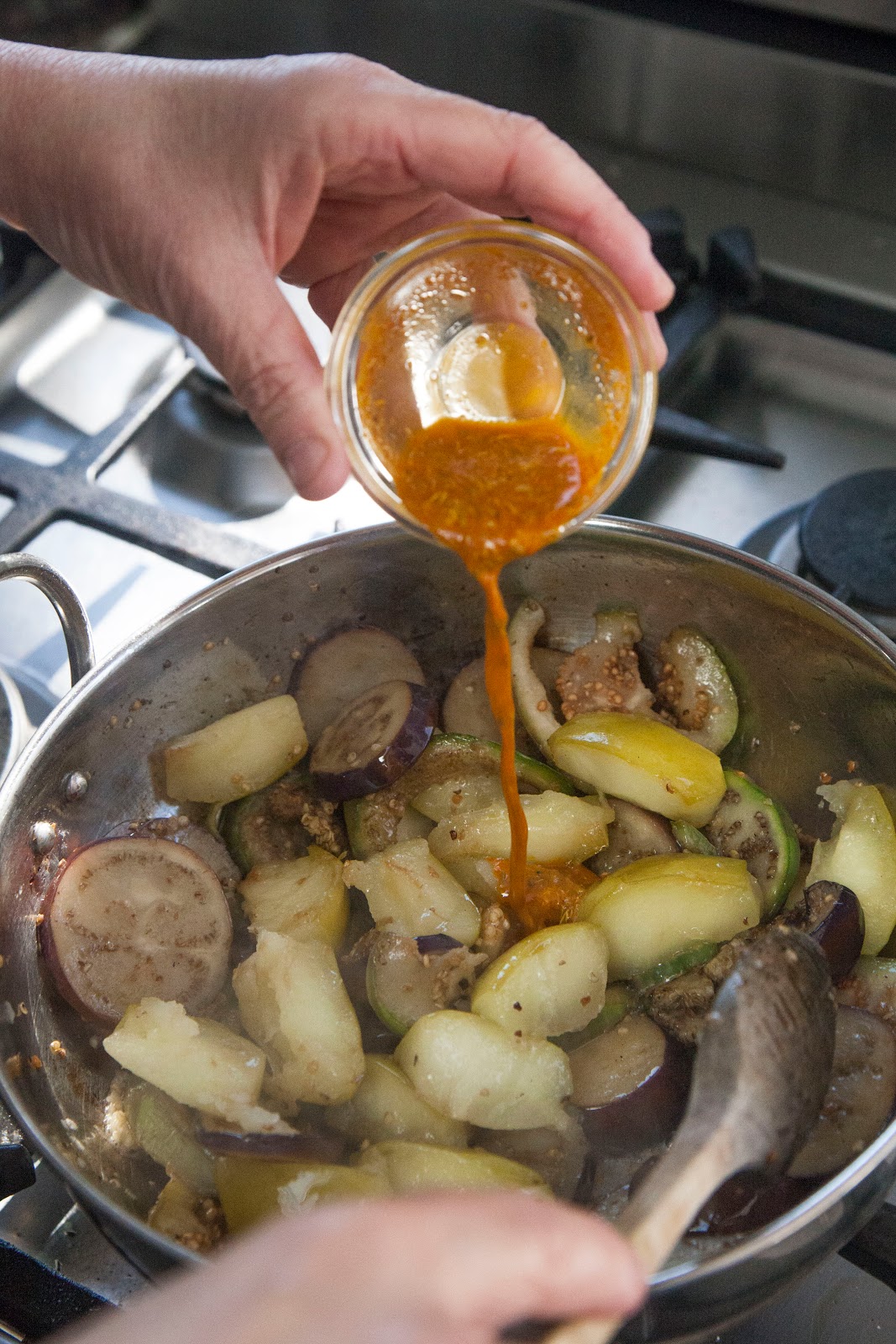
Pour the spice paste into the pan with them and stir gently.


Turn the heat to low and cook for about 10 minutes. Turn the apple and eggplant pieces over gently to coat them and make sure you don't break them.


Lift them out of the pan with a slotted spoon and serve them up.


   This is a very clean and simple dish with a delicate flavor, just right for  a day when you don't want to spend hours in the kitchen. It's also vegan, and gluten free. Coming up next more Indian seasonal specials and  While you're here subscribe to our feed!   And follow along on Twitter @kathygori 

Friday, October 9, 2015

Easy, Peasy. Cabbage and Peas, Bengali Style, #Vegan and #Gluten Free


   I grew up as a city kid in San Francisco before the time of crazy real estate prices and the influx of Silicon Valley Money. We lived in a working class neighborhood, where houses like the one I lived in most of my early life now sell for gazillions of dollars. Money was tight around our house and Thursdays (payday) were a big deal. My mom would go out and buy meat. Big whoop! Between paychecks we ate a lot of vegetables, unfortunately, most of them frozen as those were cheap and easy to fix. We also had a LOT of those 98 cent boxes (yeah I'm dating myself) of Kraft Mac and Cheese. If a neighbor went fishing in the Bay the whole block got in on the catch and we had fresh fish, but vegetables...not so much. One year I decided I'd attempt to grow some vegetables in our backyard such as it was. I bought seeds, planted them and at harvest time, got 2 zucchini and 1 pod of peas. That was the end of my "urban farming." It was back to Lima beans in a freezer bag and bell pepper surprise on the Wednesday before paydays.

   Flash forward to the present and I finally got my growing act together. I've always enjoyed foraging, both around the neighborhood in Santa Monica, and here in Sonoma, but this year we really got serious and planted a serious ass garden! When we bought our new house last year, besides doing interior renovation to make it water and energy efficient, as "green" as we could, we also took out the lawn and xeriscaped  both in front and in back. We put in 7 big raised growing beds, along with fruit trees, and this summer we started  reaping what we had sown.

   Here in Sonoma, there are a lot of farms so fresh vegetables are all over the place, but good organic stuff still can have a pricey sticker so we concentrated on planting things we loved and I cooked a lot in my Indian dishes. A lot of then veggies we grow are things that have a higher price tag in the markets. This Butternut squash for instance..all 8 and 1/2 lbs of it, organically grown, would coast 3 bucks a pound at the store, yet it's only one of the monsters I have in the garden. Prepare for a lot of squash recipes.


There are some vegetables however that are available very cheaply, and those I did not bother to plant, chief among these is cabbage.

   Cabbage is one of my favorite vegetables. It's amazingly versatile and can be found in almost every cuisine on the planet. There are a lot of cabbage dishes in the Indian kitchen most of them very easily, and inexpensively prepared. This Begali cabbage dish, aka Torkari is one of them. Just a note before starting. A very easy, in a cheap way, to fix this dish is to use bags of pre-shredded cabbage that are sold for coleslaw. These bags usually cost about 1 dollar and I recommend them for economy's sake for those who don't feel they'd like to commit to an entire cabbage. It's also a hell of a lot easier if you don't have the time or inclination to chop and shred. This dish can be on your table in under an hour which makes it a real keeper for work days.

Bengali Cabbage, Potato, and Peas


Here's What You Need:
1 cup of shredded fresh cabbage ( or 1 8 oz bag of preshredded coleslaw cabbage)
1 large boiling potato (cubed)
1 curry leaf (optional)
1 tsp cumin seed
1/2 cup of green peas (fresh or frozen)
3 Tbs vegetable oil (I use coconut oil)
1 large tomato fresh or 1 16 oz can of chopped tomatoes
1 tsp ginger paste
1/2 tsp turmeric
1/2 tsp kashmiri chili
2 tsp salt
1 tsp sugar
1/2 tsp ground cumin
1/2 tsp garam masala


Here's What To Do:

Traditionally, this dish is cooked by frying the uncooked potato in oil but I find if one wants to reduce the amount of oil in a dish, this isn't the greatest idea. Potatoes like eggplants tend to really soak up the oil, so what I do is quickly boil or steam the potato while I'm chopping up the other ingredients. This takes about 15 minutes. Cut the potato in quarters and drop it unpeeled in some water, by the time it boils it'll be pretty much cooked. When it's fork tender, it's ready.  Drain it, run cold water over the cooked pieces and set it aside to cool.

Place the grated cabbage in a bowl and pour cold water over it to cover.


Set it aside to soak for 30 minutes.
Peel the cooled, cooked potato.


Chop the potato into cubes.


Set them aside.
Make the ginger paste. Cut a 1 inch piece of raw peeled ginger into thin slices.


Place the ginger slices into a grinder along with the ground cumin, turmeric...


...and Kashmiri chili.


Add a teeny bit of water...


...and grind it into a paste.


That is your ginger paste.
Slice the fresh tomato, then chop it. This one is right out of our garden.

 
When the cabbage has soaked for 30 minutes, drain it.


 Heat 3 Tbs of vegetable oil in a skillet or kadhai. I use Sonoma Harvest Organic Coconut Oil.


When the oil is hot toss in the cubed potato.


Since the potato is already cooked, you just want to stir it around a bit so it crisps slightly.
Now, add in the curry leaf (if you are using it) and the cumin seeds.


When the cumin seeds start to sizzle add in the chopped tomato.


Stir it around toss in some salt to taste.


Cover the pan, and cook the tomato until it's soft.
When the tomato is nice and soft add in 1 tsp of the ginger paste.


Cook, stirring things around until they're well mixed and the oil in the pan starts to separate from the spices.
Add in the peas...


...and the drained cabbage.


Mix everything together well, then turn down the heat, cover the pan and let things simmer for about 20 minutes.
Take the lid off the pan, and if you have a lot of water coming off the cabbage, turn the heat up and let the water evaporate from the pan.
When the water has evaporated toss in the garam masala, and the sugar. Check for seasoning. Add more salt if necessary.


If you  are not vegan, at this point you can drizzle 1 melted tablespoon of butter or ghee over the finished dish before serving. This is not required however.
Serve it up!


   Spicy, sweet and crunchy, this is a delicious dish that requires nothing more than some rice and chapatti for an easy Indian lunch, or you can pair it with any Western meal for a great and inexpensive side. I love cooking with cabbage almost any time of year and those little bags of coleslaw cabbage are a real money and time saver. Coming up next a very special dessert, care of CocoaPlanet Chocolate. Follow along on Twitter at @kathygori

LinkWithin

Blog Widget by LinkWithin